
How to Squat Properly: The Complete Guide to Mastering Your Squat


How to Squat Properly: The Complete Guide to Mastering Your Squat
The squat is one of the most important movements you can master in the gym.
Whether your goal is to build bigger legs, get stronger, improve your powerlifting total, or simply move better, learning how to squat properly gives you a foundation you can build on for years.
But there is no single squat stance or technique that works perfectly for everyone. Your anatomy, ankle and hip mobility, proportions, training goals, and the type of squat you're performing can all change what your ideal squat looks like.
The fundamentals, however, remain remarkably consistent.
You need a stable foot. You need to stay balanced. You need to brace your core. Your knees need to move naturally with your feet. And you need enough mobility to reach your desired depth without losing control.
In this guide, we'll break down everything you need to know to improve your squat — from finding your ideal stance to fixing common squat problems and choosing the right equipment.
How to Squat Properly: The 7 Fundamentals
If you want to improve your squat, start with these seven fundamentals:
- Find a squat stance that works with your anatomy.
- Create a stable foot position before every rep.
- Brace your core before you descend.
- Keep yourself and the bar balanced over your mid-foot.
- Allow your knees to track naturally with your toes.
- Squat to a depth you can control.
- Maintain your position as you drive back up.
Let's look at each one in more detail.
1. Find Your Ideal Squat Stance
One of the first questions lifters ask is: How wide should my squat stance be?
There isn't one universal answer.
A good starting point is to place your feet approximately shoulder-width apart with your toes turned slightly outward. From there, you can adjust your stance based on your anatomy, mobility, and comfort.
Some lifters naturally squat better with a narrow stance. Others need a wider stance to comfortably reach depth.
Your hip anatomy plays an important role here. Differences in the structure of the hip joint mean that two people may need different stance widths and toe angles even if they're performing the same exercise.
Try this: During your warm-up, perform several bodyweight squats with different stance widths. Start narrow and gradually move your feet wider. Pay attention to where you can squat deepest while keeping your feet planted and maintaining good balance.
Your ideal stance is usually the position where you feel strong, stable, and unrestricted.
2. Create a Stable "Tripod Foot"
A strong squat starts at the floor.
Before you descend, establish three solid points of contact with the ground:
- Your heel
- The base of your big toe
- The base of your little toe
Together, these three points create what is often called a tripod foot.
The goal is to maintain pressure through all three points throughout the squat.
If your weight shifts too far forward, you may lose heel contact or feel yourself falling toward your toes. If you shift too far backward, you may lose pressure through the front of your foot and struggle to stay balanced.
Think about gripping the floor with your entire foot and maintaining that connection throughout every rep.
A stable foot gives your knees and hips a stronger foundation to move from.
3. Learn How to Brace Your Core for Squats
Proper bracing is one of the most important skills you can learn for heavy squatting.
Before you descend, take a deep breath and expand your midsection. Instead of simply pushing your stomach forward, think about creating pressure around your entire torso — your stomach, sides, and lower back.
Then tighten your core as if someone were about to punch you in the stomach.
This creates intra-abdominal pressure and increases the stiffness of your torso, helping you maintain a stronger position under load.
For heavy squats, many lifters use a lifting belt to reinforce this process.
A lifting belt gives your abdominal muscles something rigid to brace against, helping you create greater pressure and trunk stiffness during heavy lifts.
The key is understanding that a belt doesn't replace proper bracing.
You should learn how to brace without a belt first. Once you understand the technique, the belt becomes a tool that can help you brace harder as the weight increases.
4. Keep the Bar Balanced Over Your Mid-Foot
One of the easiest ways to evaluate squat technique is to look at the bar path from the side.
During a balanced squat, the barbell should remain relatively centered over your mid-foot as you descend and stand back up.
This doesn't mean your torso must stay perfectly vertical.
Your torso angle depends on several factors, including:
- Your bar position
- Your torso length
- Your femur length
- Your ankle mobility
- Your squat stance
A lifter with long femurs, for example, may naturally lean forward more than someone with shorter femurs.
The important question isn't whether your torso is perfectly upright.
It's whether you remain balanced.
If the bar drifts too far forward, you may find yourself shifting onto your toes or turning the squat into a good morning as you stand up.
Film your squat from the side. If the bar remains roughly over the middle of your foot throughout the movement, you're generally maintaining a balanced bar path.
5. Should Your Knees Go Over Your Toes When Squatting?
Yes. For most healthy lifters, it is completely normal for the knees to travel past the toes during a squat.
The old advice that your knees should never move beyond your toes is an oversimplification.
As you squat deeper, your knees often need to move forward to keep your body balanced over your feet. This is especially true during high-bar squats, front squats, and heel-elevated squats.
How far your knees travel depends on your anatomy, squat style, stance, and ankle mobility.
Instead of worrying about whether your knees cross an imaginary line over your toes, focus on two things:
- Keep your entire foot connected to the floor.
- Allow your knees to track in the same general direction as your toes.
Your knees should move naturally as part of the squat.
6. How Deep Should You Squat?
Another common question is: How deep should you squat?
The answer depends on your goals and your ability to control the movement.
For powerlifting, competition standards generally require the hip crease to descend below the top of the knee.
For general strength and muscle development, you can squat through the deepest range of motion that you can comfortably control while maintaining balance and a strong position.
That might be parallel for one lifter and a full-depth squat for another.
Don't force additional depth if reaching it causes:
- Your heels to lift
- Your feet to collapse
- Your balance to shift dramatically
- Your lower back to excessively round
- Pain
Instead, identify what is limiting your squat and work on improving it.
7. Drive Out of the Bottom Without Losing Position
The bottom of the squat — sometimes called "the hole" — is where many lifters lose their technique.
As you begin standing up, try to maintain the same balance and torso position you established during the descent.
Your hips and shoulders should generally rise together.
If your hips shoot upward much faster than your shoulders, the bar may drift forward and turn your squat into a good morning.
This often happens because:
- The weight is too heavy.
- You lost your brace.
- Your quads aren't strong enough to maintain the position.
- Your starting position isn't suited to your anatomy.
Instead of simply thinking about standing up, think about driving your entire body upward while keeping the bar balanced over your mid-foot.
Why Ankle Mobility Matters for Squats
Ankle mobility is one of the most common factors that can limit squat depth.
During a squat, your ankle needs to dorsiflex — meaning your knee moves forward while your heel remains connected to the ground.
If your ankle can't move far enough, your body has to compensate somewhere else.
You may notice:
- Your heels lifting off the ground.
- Your feet turning excessively outward.
- Your torso leaning farther forward.
- Difficulty reaching squat depth.
- Loss of balance at the bottom.
How to Test Your Ankle Mobility
One simple assessment is the knee-to-wall test.
Place your foot flat on the floor in front of a wall. Keeping your heel down, drive your knee forward until it touches the wall.
Gradually move your foot farther away and repeat.
If you struggle to move your knee forward without your heel lifting, ankle mobility may be affecting your squat.
How to Squat With Limited Ankle Mobility
If limited ankle mobility is preventing you from reaching a comfortable squat depth, there are ways to adjust your setup while you work on improving your mobility.
One of the simplest solutions is to elevate your heels. Raising the heels reduces the amount of ankle dorsiflexion required during the squat, allowing the knees to travel forward more easily while helping you maintain a more upright torso.
This can make it easier to reach a deeper, more comfortable squat position without your heels lifting off the ground or your balance shifting forward.
You can elevate your heels using weightlifting shoes with a raised heel or squat wedges, which allow you to adjust your foot position and heel elevation depending on the exercise.
Heel elevation isn't only useful for lifters with limited ankle mobility. It also changes the mechanics of the squat by increasing forward knee travel and knee flexion, which can place greater emphasis on the quadriceps.
For this reason, heel elevation is commonly used for:
- Deep squats
- Quad-focused squats
- Goblet squats
- Split squats
- Squat technique practice
If ankle mobility is limiting your squat, heel elevation can help you continue training through a comfortable range of motion while you work on improving the underlying restriction. If your goal is quad development, it can also be used intentionally as part of your regular training.
High-Bar vs. Low-Bar Squat: What's the Difference?
The main difference between a high-bar and low-bar squat is where the barbell sits on your back.
High-Bar Squat
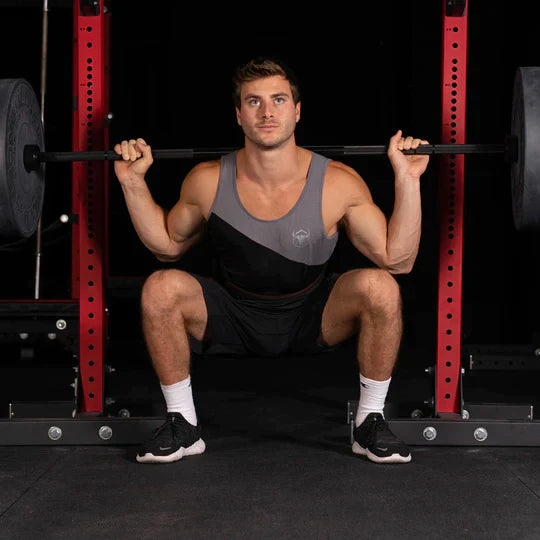
In a high-bar squat, the bar rests higher on the upper traps.
This generally allows or requires a more upright torso and greater forward knee travel.
High-bar squats are commonly used for:
- Olympic weightlifting
- Bodybuilding
- General strength training
- Quad development
Low-Bar Squat
In a low-bar squat, the bar sits lower across the rear delts.
This typically creates more forward torso lean and places greater demand on the hips and posterior chain.
Low-bar squats are particularly common in powerlifting because many lifters can move heavier loads with this technique.
Which Squat Is Better?
Neither is universally better.
If your goal is maximum squat strength for powerlifting, low bar may be worth exploring.
If your goal is Olympic weightlifting, general strength, or quad development, high bar may be a better fit.
Ultimately, the best squat variation is the one that fits your anatomy, mobility, goals, and training style.
Should You Wear Knee Sleeves for Squats?
You don't need knee sleeves to squat, but many lifters prefer wearing them during heavier or higher-volume training.
Knee sleeves provide compression around the knee and help retain warmth around the joint.
The compression can also increase your awareness of the knee joint while you're squatting, which some lifters find improves their sense of stability and confidence under load.
Knee sleeves are particularly popular for:
- Heavy squats
- Powerlifting
- Olympic weightlifting
- High-volume leg training
- Lifters who prefer additional warmth and compression around the knees
However, knee sleeves should never be used to mask pain or compensate for poor squat technique.
If you experience persistent knee pain while squatting, identify the cause rather than simply adding more support.
Should You Wear a Lifting Belt for Squats?
A lifting belt can be extremely useful as your squat gets heavier.
When you brace correctly against a belt, you can create greater pressure around your midsection and increase torso stiffness.
This can help you maintain a stronger position when squatting heavy loads.
But there is no specific percentage of your one-rep max where everyone suddenly needs to start wearing a belt.
Some lifters use a belt for most working sets. Others reserve it for their heaviest sets.
A practical approach is to perform some lighter training without a belt and introduce your belt as the intensity increases.
Most importantly, learn how to brace correctly with and without one.
Should You Use a Barbell Pad for Squats?
A barbell pad can make squatting more comfortable if the bar creates pressure or discomfort across your upper back and traps.
This is especially common with high-bar squats, where the bar rests directly on the upper traps. Newer lifters may also find that the pressure of the bar distracts them from focusing on their squat technique.
A barbell pad adds cushioning between the bar and your body, which can help reduce discomfort during higher-volume squat sessions.
Barbell pads can be particularly useful for:
- High-bar squats
- Beginners who are still getting comfortable with a barbell on their back
- Higher-rep squat workouts
- Lifters who experience discomfort from direct bar pressure
- Hip thrusts and other barbell exercises where cushioning improves comfort
However, a barbell pad isn't necessary for everyone. Many experienced lifters prefer squatting without one because direct contact with the bar can provide a more secure and consistent bar position.
If you use a barbell pad, make sure the bar still sits securely on your upper back and doesn't roll or shift during the movement.
For low-bar squats, a barbell pad is generally less common because the bar needs to sit securely across the rear delts, and additional padding can make it harder to maintain a stable bar position.
The bottom line: use a barbell pad if it makes your squat more comfortable without compromising your bar position or control.
Common Squat Mistakes and How to Fix Them
1. Your Heels Lift When You Squat
If your heels lift during the squat, first check your ankle mobility and balance.
Limited ankle dorsiflexion can make it difficult for your knees to move forward while keeping your heels planted.
Work on ankle mobility and consider experimenting with heel elevation using squat wedges.
2. Your Knees Cave In
Some knee movement is normal, especially under heavy loads. The bigger concern is significant, uncontrolled inward collapse.
Focus on maintaining your tripod foot and allowing your knees to track in line with your toes.
If your knee position becomes significantly worse as the weight increases, reduce the load and rebuild control.
3. You Lean Too Far Forward
Forward torso lean isn't automatically bad.
Low-bar squatters and lifters with longer femurs will naturally lean forward more.
The problem occurs when you lose balance and the bar drifts significantly in front of your mid-foot.
Check your ankle mobility, bracing, stance, and bar position before assuming you simply need to "keep your chest up."
4. Your Hips Shoot Up First
If your hips rise faster than your shoulders, you may be losing your position out of the bottom.
Reduce the load and focus on maintaining your brace while driving your hips and shoulders upward together.
5. You Can't Squat Deep Enough
Squat depth can be influenced by:
- Ankle mobility
- Hip anatomy
- Squat stance
- Toe angle
- Balance
- Bar position
Don't assume you simply need to stretch more.
Test each potential limitation individually and see how your squat changes.
How to Improve Your Squat
If you want to get better at squatting, treat the squat like a skill.
Practice the movement consistently instead of testing your maximum strength every session.
Before your working sets:
- Perform a general warm-up.
- Address any mobility restrictions that affect your squat.
- Practice bodyweight or goblet squats.
- Perform several progressively heavier warm-up sets.
- Film your heavier sets occasionally to evaluate your technique.
Pay attention to your stance, foot pressure, knee tracking, bracing, depth, and bar path.
As the weight increases, your technique should remain relatively consistent.
If your squat suddenly looks completely different when the bar gets heavy, you've probably exceeded the load you can currently control with good technique.
Your Squat Checklist
Before your next squat session, remember these fundamentals:
- Stance: Find the width and toe angle that work with your anatomy.
- Feet: Maintain a stable tripod foot.
- Brace: Create 360-degree pressure around your core before descending.
- Balance: Keep yourself and the bar balanced over your mid-foot.
- Knees: Allow them to track naturally in line with your toes.
- Depth: Squat through the deepest range you can control.
- Ascent: Maintain your position as you drive out of the bottom.
Frequently Asked Questions About Squats
What muscles do squats work?
Squats primarily train the quadriceps, glutes, and adductors while also requiring significant involvement from the core and back muscles to stabilize your torso and the barbell.
How deep should you squat?
You should generally squat through the deepest range of motion you can comfortably control while maintaining balance and a strong position. Competitive powerlifters must also meet the depth requirements of their federation.
Should your knees go past your toes when squatting?
Yes. It is normal for the knees to travel past the toes during many squat variations. The amount of forward knee travel depends on your anatomy, mobility, stance, and squat style.
Why can't I squat deep?
Limited squat depth can result from ankle mobility, your stance, hip anatomy, balance, or your squat technique. Identifying the specific limitation is more useful than assuming you simply need more flexibility.
Can squat wedges improve squat depth?
Elevating the heels with squat wedges reduces the amount of ankle dorsiflexion required and can make it easier for some lifters to reach a deeper squat while maintaining a more upright torso.
Are squat wedges only for poor ankle mobility?
No. Squat wedges can also be used intentionally to increase knee flexion and emphasize the quadriceps during exercises such as heel-elevated squats and split squats.
Do knee sleeves help with squats?
Knee sleeves provide compression and help retain warmth around the knee. Many lifters prefer the feeling of additional compression and support during heavy or high-volume squat training.
Should I wear a lifting belt when squatting?
A lifting belt can help you create greater trunk stiffness when you brace correctly against it. It is most commonly used as squat intensity increases, although when you choose to wear one depends on your training style and preferences.
Is high-bar or low-bar better?
Neither squat style is universally better. High-bar squats generally involve a more upright torso and greater knee flexion, while low-bar squats typically involve more torso lean and hip contribution. Choose based on your goals, anatomy, mobility, and comfort.
Why do I lean forward when I squat?
Some forward lean is completely normal. The amount depends on your proportions, bar position, stance, and ankle mobility. Excessive forward movement becomes a problem when you lose balance or the bar drifts significantly forward of your mid-foot.
Master the Movement Before You Chase the Weight
A great squat isn't defined by one perfect stance or a single technique cue.
It's the result of finding the positions that work with your body and then practicing them until they become repeatable.
Build your squat from the ground up. Create a stable foot. Find your stance. Improve your mobility where needed. Learn how to brace. Control your depth. Then progressively add weight while maintaining those positions.
As your training gets heavier, the right equipment can help support your performance and make your training more comfortable. Lifting belts can help reinforce your brace, knee sleeves provide compression and warmth around the knees, squat wedges allow you to modify heel elevation and squat mechanics, and barbell pads can reduce upper-back discomfort during high-bar and higher-volume squatting.
Master the movement first. Build strength on top of it. Then keep refining your squat one rep at a time.